Impact Factor
Call For Paper
Volume 12 Issue 10
October 2026
Download Paper Format
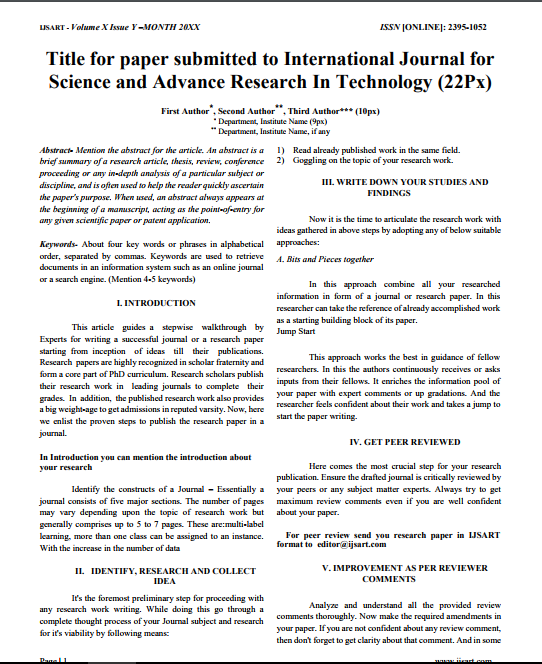
Copyright Form
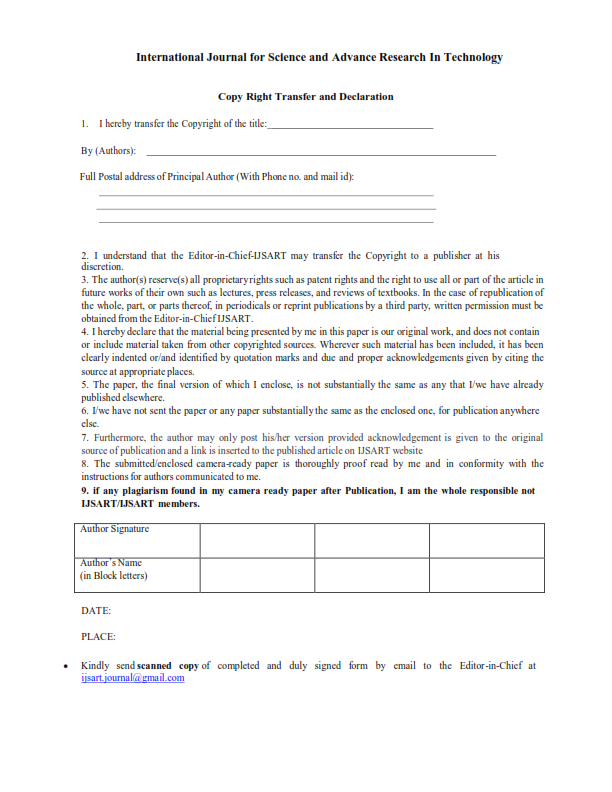

Author(s)
Abstract
Printed Circuit Boards (PCBs) Serve As The Structural And Electrical Foundation Of Virtually Every Modern Electronic Device, Making Their Quality And Reliability Paramount In Both Consumer And Industrial Electronics. Defects Introduced During PCB Fabrication And Assembly — Including Missing Holes, Open Circuits, Solder Bridging, Mouse Bites, Spurious Copper Deposition, And Component Misalignment — Can Precipitate Device Failures, Safety Hazards, And Substantial Economic Losses Across The Manufacturing Supply Chain. Traditional Manual Inspection Approaches Are Inadequate For High-throughput Production Due To Their Low Throughput, Susceptibility To Human Error, And Inability To Detect Subtle Microscopic Anomalies. Classical Automated Optical Inspection (AOI) Systems Based On Template Matching Offer Partial Improvements But Remain Brittle Against Illumination Variations, PCB Surface Reflectivity, And Design Diversity. This Paper Presents A Comprehensive YOLOv11-based Automated PCB Defect Detection And Quality Assessment System Specifically Engineered For Smart Manufacturing Environments. The Proposed Framework Encompasses Five Integrated Modules: Dataset Collection, Data Preprocessing With Augmentation, YOLOv11 Model Fine-tuning With Transfer Learning, Real-time Multi-class Defect Detection, And A Post-detection Quality Assessment Pipeline Comprising Defect Classification, Severity Scoring, And Corrective Recommendation Generation. Experimental Evaluation Demonstrates A Detection Accuracy Of 92%, Precision Of 91%, Recall Of 90%, And F1-score Of 90.5%, Substantially Outperforming Manual Verification (60%), Traditional Image Processing (68%), CNN-based Classification (78%), And Semi-supervised Learning Approaches (83%). Real-time Inference Is Achieved At Approximately 22 Ms Per Image On Standard CPU Hardware, Satisfying Industrial Throughput Requirements.
Keywords
Paper ID
IJSARTV12I4104948
Publication Date
April 9, 2026
Research Area
CSE