Impact Factor
Call For Paper
Volume 12 Issue 10
October 2026
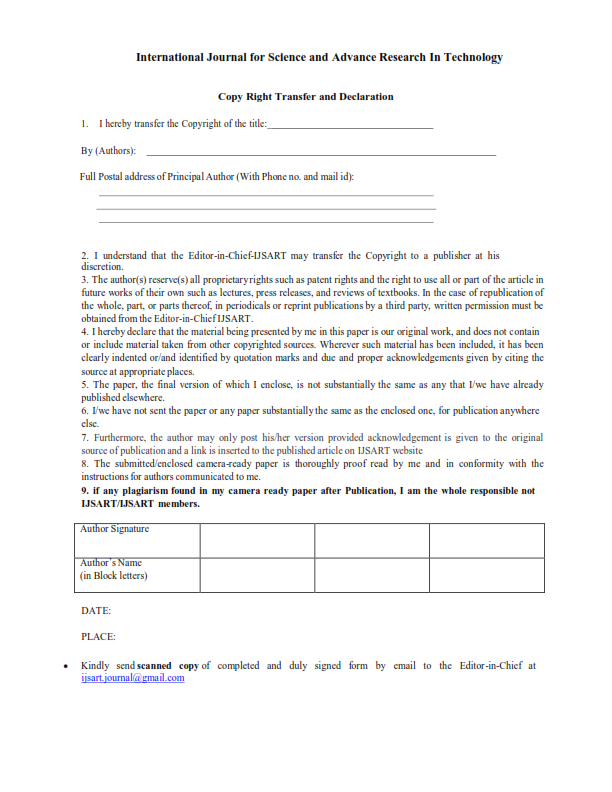
Download Paper Format
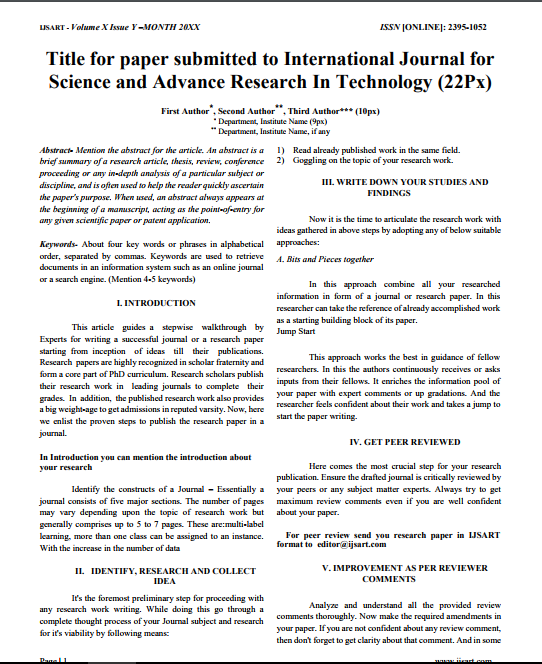
Copyright Form

Author(s)
Abstract
Non-invasive Glucose Monitoring Remains A Critical Challenge In Biomedical Engineering Due To The Complex Interaction Of Light With Biological Tissues And The Weak Specificity Of Glucose-related Optical Signals. This Paper Presents The Design And Implementation Of A Wearable Non-invasive Glucose Monitoring System Based On Near-Infrared (NIR) Optical Sensing. The Proposed System Utilizes A 940 Nm NIR Light Source, Selected Within The Optical Window That Minimizes Water Absorption While Ensuring Adequate Penetration Into The Skin. The Sensing Principle Is Based On The Beer–Lambert Law, Where The Attenuation Of Light Intensity Is Related To The Absorption Coefficient Of The Medium, Which Is Influenced By Glucose Concentration. A Photodiode Detects The Diffusely Reflected Light, And The Resulting Signal Is Amplified, Filtered, And Digitized Using An ESP32 Microcontroller. Signal Preprocessing Techniques Are Applied To Reduce Noise And Improve Measurement Stability. The Processed Data Is Transmitted Wirelessly To A Mobile Application Via Bluetooth Low Energy (BLE) For Real-time Monitoring. Due To The Presence Of Significant Optical Scattering, Physiological Variability, And Dominant Water Absorption, The Extracted Signal Represents A Composite Response Rather Than A Glucose-specific Measurement. Therefore, The Current System Focuses On Demonstrating Feasibility Rather Than Achieving Clinical-grade Accuracy. Experimental Results Confirm Successful Signal Acquisition And Wireless Transmission, Validating The System Architecture. Future Work Will Involve Multi-wavelength Sensing, Advanced Signal Processing, And Machine Learning-based Calibration Models To Improve Accuracy And Robustness. This Study Contributes Toward The Development Of Practical, Wearable, And Non-invasive Glucose Monitoring Technologies.
Keywords
Paper ID
IJSARTV12I4105211
Publication Date
April 30, 2026
Research Area
Artificial Intelligence And Data Science