Impact Factor
Call For Paper
Volume 12 Issue 10
October 2026
Download Paper Format
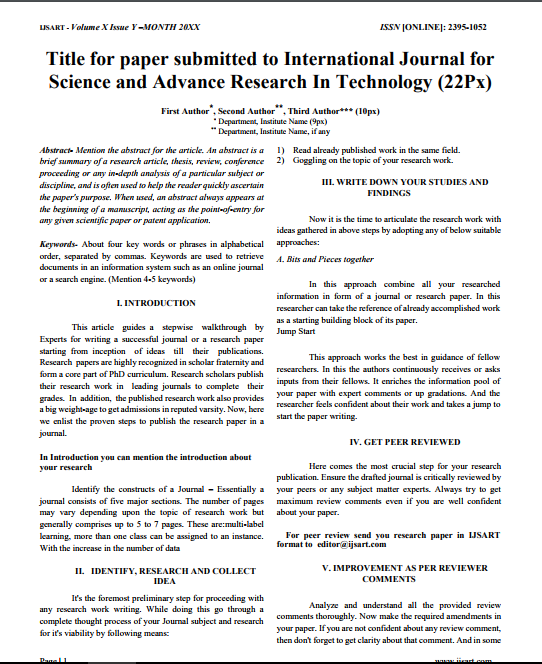
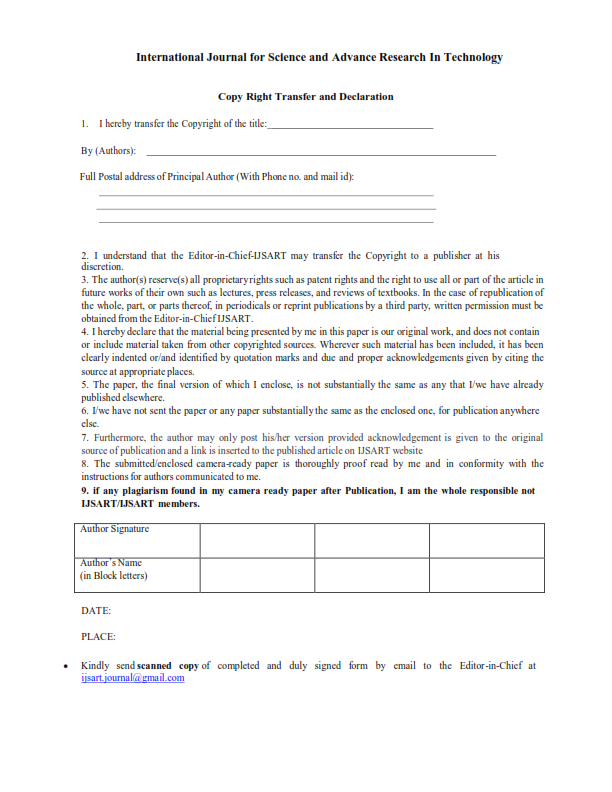
Copyright Form

Author(s)
Abstract
This Study Presents A Short-term, High-resolution Assessment Of Ambient Air Quality In Pune, Maharashtra, India, Using 30 Consecutive Days Of Continuous Monitoring Data (February 16 To March 17, 2026) From Government-operated Continuous Ambient Air Quality Monitoring Stations (CAAQMS). Six Pollutants Were Analysed: PM2.5, PM10, CO, SO2, NO2, And O3. The Period-mean Air Quality Index (AQI) Was 106.0 ± 44.8, With Daily Values Ranging From 30 To 188. PM2.5 Exceeded The Central Pollution Control Board (CPCB) 24-h National Ambient Air Quality Standard (NAAQS) Of 60 μg/m³ On 9 Of 30 Days (30 %). PM2.5 And PM10 Co-varied Near-perfectly (r = 0.9997), With A Mean PM2.5/PM10 Mass Ratio Of 0.84 ± 0.01, A Pattern Consistent With Combustion-dominated Aerosol. Three Distinct Temporal Phases Were Identified And Provisionally Attributed To Winter-inversion-enhanced Traffic Emissions, A Synoptic Flushing Event, And A CO-elevated Pre-monsoon Transition. The Study Is Explicitly Limited In Scope: It Covers A Single Meteorological Transition Season, Lacks Co-located Meteorological Measurements And Source-apportionment Analysis, And Cannot Support Causal Attribution. On The Basis Of The Observed Exceedances And Phase Structure, Evidence-anchored Recommendations For Vehicular Emission Control, Industrial Monitoring, And Network Expansion Are Proposed.
Keywords
Paper ID
IJSARTV12I6105586
Publication Date
June 2, 2026
Research Area
Computer Engineering