Impact Factor
Call For Paper
Volume 12 Issue 10
October 2026
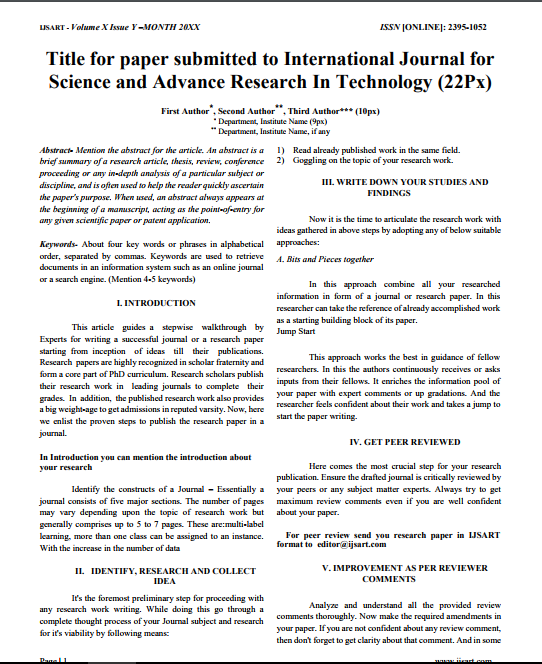
Download Paper Format
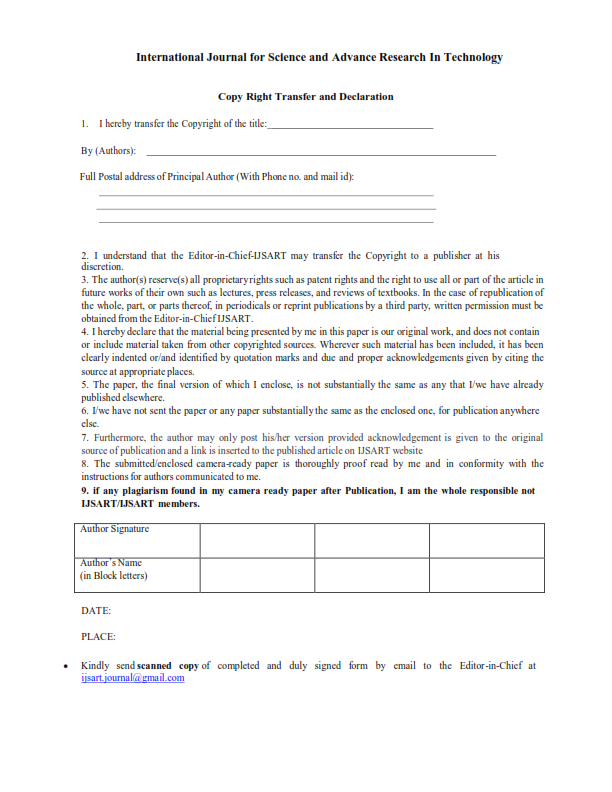
Copyright Form

Author(s)
Abstract
Healthcare Is One Of The Most Important Research Fields With The Rapid Improvement Of Technology And Increase In Data. It Is Difficult To Handle Huge Amounts Of Patient Data. Big Data Analytics Can Be Used To Handle Such Data. There Are A Lot Of Procedures For The Treatment Of Multiple Diseases Across The World. Machine Learning Is A Prominent Approach That Helps In Prediction And Diagnosis Of A Disease.In The Existing System,diagnosis At An Early Stage Can Be Difficult As A Lot Of Diseases Might Have Very Common Symptoms And Require A Professional To Identify The Illness. Besides, A Lot Of Patients Delay Visiting A Doctor Because Of The Lack Of Information And Availability. Therefore, To Tackle This Problem, A System That Will Be Able To Give Some Hints About The Patient's Health Issues Is Developed. The Proposed System, “Enhancing The Recommendation Model For Disease Prediction Based On User Symptoms Using Machine Learning,” Presents An Effective Approach For Predicting Diseases And Providing User-centered Health Recommendations. By Integrating Multiple Machine Learning Algorithms Such As Random Forest, Support Vector Machine, Naïve Bayes, Decision Tree, And K-Nearest Neighbors Through An Ensemble Voting Model, The System Achieves Improved Prediction Accuracy, Robustness, And Reliability Compared To Traditional Single-model Approaches. The Implementation Of Pre-processing And Feature Engineering Techniques Enhances Data Quality And Optimizes Model Performance, Enabling The System To Handle Noisy And Diverse Symptom Data Effectively. In Addition To Disease Prediction, The Inclusion Of A Recommendation Module Provides Meaningful Precautions And Lifestyle Suggestions, Increasing The Practical Usefulness Of The System For End Users. The Developed Interface Ensures A User-friendly And Accessible Environment For Symptom Analysis And Prediction. Performance Evaluation Demonstrates That The Proposed Approach Produces Accurate And Consistent Results While Supporting Continuous Improvement Through Feedback Mechanisms.
Keywords
Paper ID
IJSARTV12I5105450
Publication Date
May 23, 2026
Research Area
Machine Learning