Impact Factor
Call For Paper
Volume 12 Issue 10
October 2026
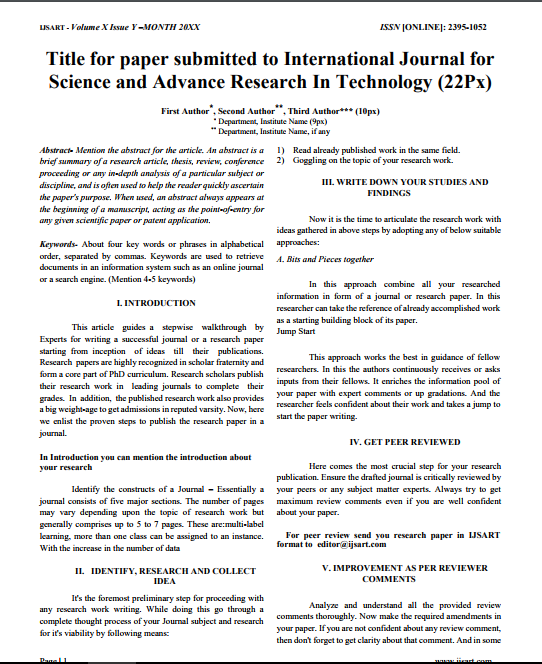
Download Paper Format
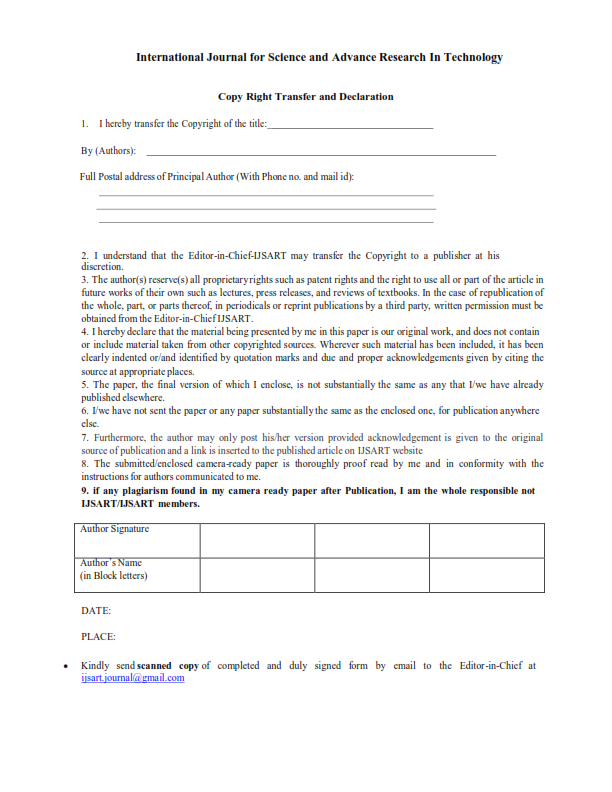
Copyright Form

Author(s)
Abstract
The Integration Of Artificial Intelligence Into Clinical Healthcare Settings Has Gained Remarkable Momentum Over The Past Decade, Offering Unprecedented Opportunities To Augment Diagnostic Capabilities And Extend Medical Reach To Underserved Populations. Among The Many Promising Applications Of This Integration, The Automated Identification Of Diseases From Patient-reported Symptom Profiles Stands Out For Its Potential To Democratize Access To Preliminary Healthcare Screening. This Paper Presents An Empirical Comparative Investigation Of Four Supervised Machine Learning Algorithms — Random Forest, K-Nearest Neighbors, Naive Bayes, And Support Vector Machine — Evaluated On The Task Of Predicting Diseases From Binary Symptom Feature Vectors. Experiments Were Conducted On A Structured Dataset Containing 4,920 Patient Records Distributed Across 41 Disease Categories And Encoded Using 131 Symptom Attributes. A Stratified 80/20 Train-test Partition Was Employed Alongside 5-fold Cross-validation To Ensure Reliable And Generalizable Performance Estimates. Among The Four Algorithms Evaluated, The Support Vector Machine Equipped With A Radial Basis Function Kernel Consistently Outperformed Its Counterparts, Attaining A Test Accuracy Of 99.19%, A Weighted F1-score Of 99.16%, And A Cross-validation Mean Of 99.27% — Results That Clearly Exceeded The 90% Performance Target Established At The Outset Of This Research. Beyond The Algorithmic Investigation, The Paper Describes The Development Of A Fully Functional Flask-based Web Application Named MediAI, Which Embeds The Trained SVM Model Within An Adaptive Symptom Collection Interface Capable Of Delivering Real-time Differential Diagnoses, Confidence-calibrated Predictions, And Actionable Clinical Guidance. These Findings Collectively Affirm That Classical Supervised Learning, When Thoughtfully Applied To Well-structured Clinical Data, Can Serve As A Reliable Foundation For Accessible And Scalable Disease Screening Systems.
Keywords
Paper ID
IJSARTV12I4104880
Publication Date
April 5, 2026
Research Area
Software Systems