Impact Factor
Call For Paper
Volume 12 Issue 10
October 2026
Download Paper Format
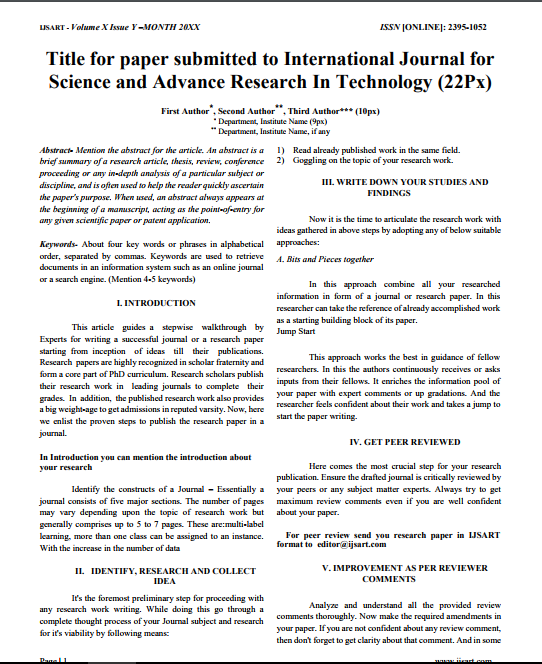
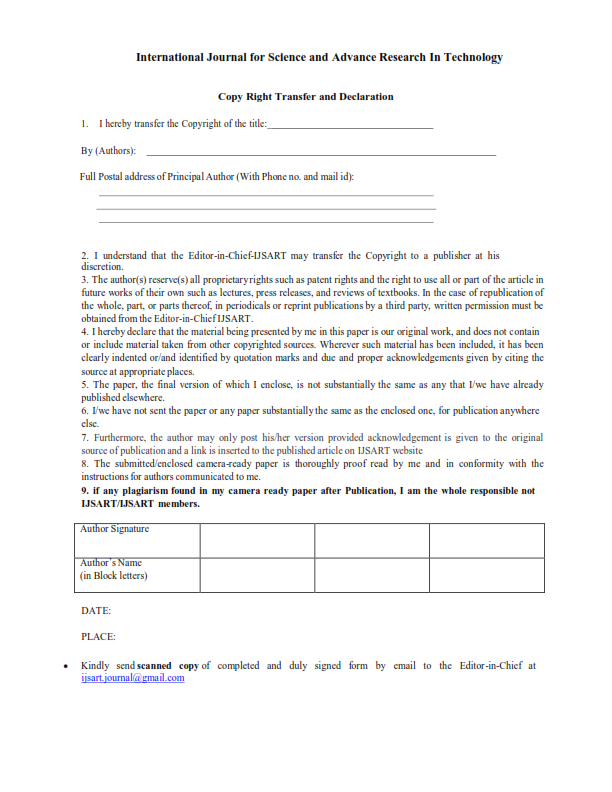
Copyright Form

Author(s)
Abstract
Conveyor Belts Are Fundamental To Any Modern Industrial Or Material-handling Facility, But Energy Efficient Operation Of A Conveyor System Is Essential For Decreasing Operational Cost. This Paper Proposes A Comparative Study Of Energy Optimization Using Response Surface Methodology And Machine Learning Models Of A Laboratory Level Conveyor Belt. A Belt Driven Rig Of Size 150cm X 25cm Was Fitted With Current, Voltage Sensors That Were Connected To An ESP32 Microprocessor. A Sensor Was Placed On The Conveyor And Sent Data To A Google Sheet Every 30 Seconds. A Three-level Full-factorial Response Surface Methodology (RSM) Design Was Subsequently Employed To Gain Insight On The Effect Of Using Object Weight (A) And Inter Object Distance (B) On The Performance Of The System. The Results Of The Analysis Of Variance (ANOVA) Showed That There Were Significant Linear Term (A), And The Quadratic Term A2 (P < 0.0001). However, Linear Term (B),a Two-factor Interaction (AB), And B2 Did Not Appear To Be Significant (P = 0.2075). The Regression Model Suggests A Minimum Energy Of 1057.16 J At The Stationary Point With The Adjusted-R2>0.977. Based On The Experimental Data Set, Six Machine Learning Algorithms Were Developed In MATLAB To Predict Conveyor Energy Consumption.The Performance Of The Models Was Evaluated Using R², Root Mean Square Error (RMSE), Mean Absolute Error(MAE), And Mean Absolute Percentage Error (MAPE). Among The Evaluated Models, Extreme Gradient Boosting (XGBoost) Achieved The Highest Prediction Accuracy And Was Subsequently Integrated With A Genetic Algorithm (GA) To Optimize Conveyor Energy Consumption. The Proposed XG Boost–GA Framework Identified The Optimal Operating Conditions Of 500.26 G Weight And 73.60 Cm Spacing, Resulting In A Minimum Predicted Energy Consumption Of 1006.57 J, Which Is Approximately 4.8% Lower Than The 1057.16 J Obtained Using Response Surface Methodology (RSM). These Results Demonstrate That Combining XG Boost With The Genetic Algorithm Is More Effective Than RSM For Minimizing Conveyor Energy Consumption.
Keywords
Paper ID
IJSARTV12I7105799
Publication Date
July 31, 2026
Research Area
Mechatronics Engineering